
Fields of Action

An integrated approach to the mobility of the future

Creating solutions together

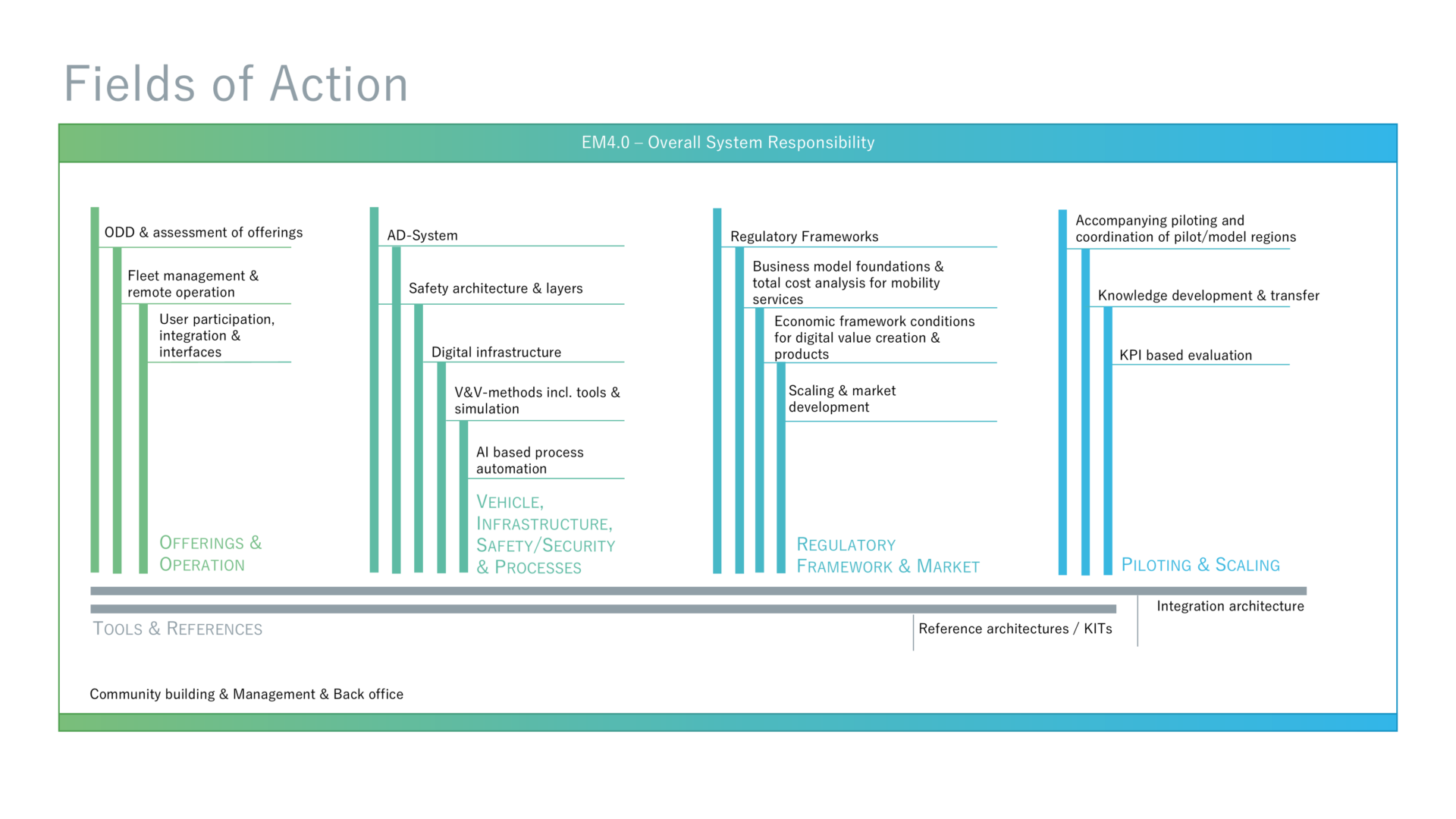
The Ecosystem Mobility 4.0 initiative structures its work into clearly defined fields of action that together form a holistic picture of the future mobility system. Each field addresses a specific aspect, ranging from organisational frameworks and technical foundations to practical market implementation.

The key element is their interaction: the fields of action are closely aligned and interlinked. Concepts, technologies and organisational structures are designed in an integrated way from the outset, with the aim of creating robust, interoperable and practical solutions.

This results in a coherent framework that systematically supports the path from idea to deployment, enabling sustainable innovation in the mobility sector.
Offerings & Operation,

In the cluster Offerings & Operation, we design concepts and tools for evaluating and managing mobility services based on ODD specifications. We also work on solutions for fleet management and remote operation of automated vehicles, as well as on user-centered interfaces for intuitive system use.

ODD & assessment of offerings

We design concepts and tools that enable the systematic evaluation and management of routes, networks, and service areas in passenger and freight transport, always based on ODD specifications that comply with industry standards.
This allows new mobility and transport services to be seamlessly integrated into existing structures and coherently consolidated. Where necessary, we actively contribute to the further development of existing ODD standards.
The result: technical feasibility, economic viability, transport benefits and the actual users´ needs are considered together from the outset – for solutions that truly work in practice.

Informed decisions for sustainable mobility

Fleet management & remote operation

We find practical, scalable solutions for fleet management and the remote operation of automated vehicles- tailored to the demands of modern mobility.
Our focus is on efficiently managing large fleets, maximising operational safety and utilisation, and developing technical functions that enable the flexible deployment of intelligent driving technologies across as many application scenarios as possible.
Our solutions ensure that automated driving is not only technically feasible, but also reliable, economical and versatile in real-world operation.

Intelligent operation of automated vehicle fleets

User participation, integration & interfaces

We analyse and structure users’ needs – both with regard to automated vehicles and the associated system technologies.
Building on this, we model design principles for services and their interfaces that ensure a consistent user experience – even in complex multi-vendor environments.
Our approaches ensure that interfaces are intuitive, consistent and practical, whether we are integrating remote operation into public transport control centres or developing planning and evaluation tools for routes, networks and service areas.
This ensures that technical systems are high-performing and easy to use for everyone involved, from operators to passengers.

Putting people at the heart of the process

Vehicle, Infrastructure, Safety/Security & Processes

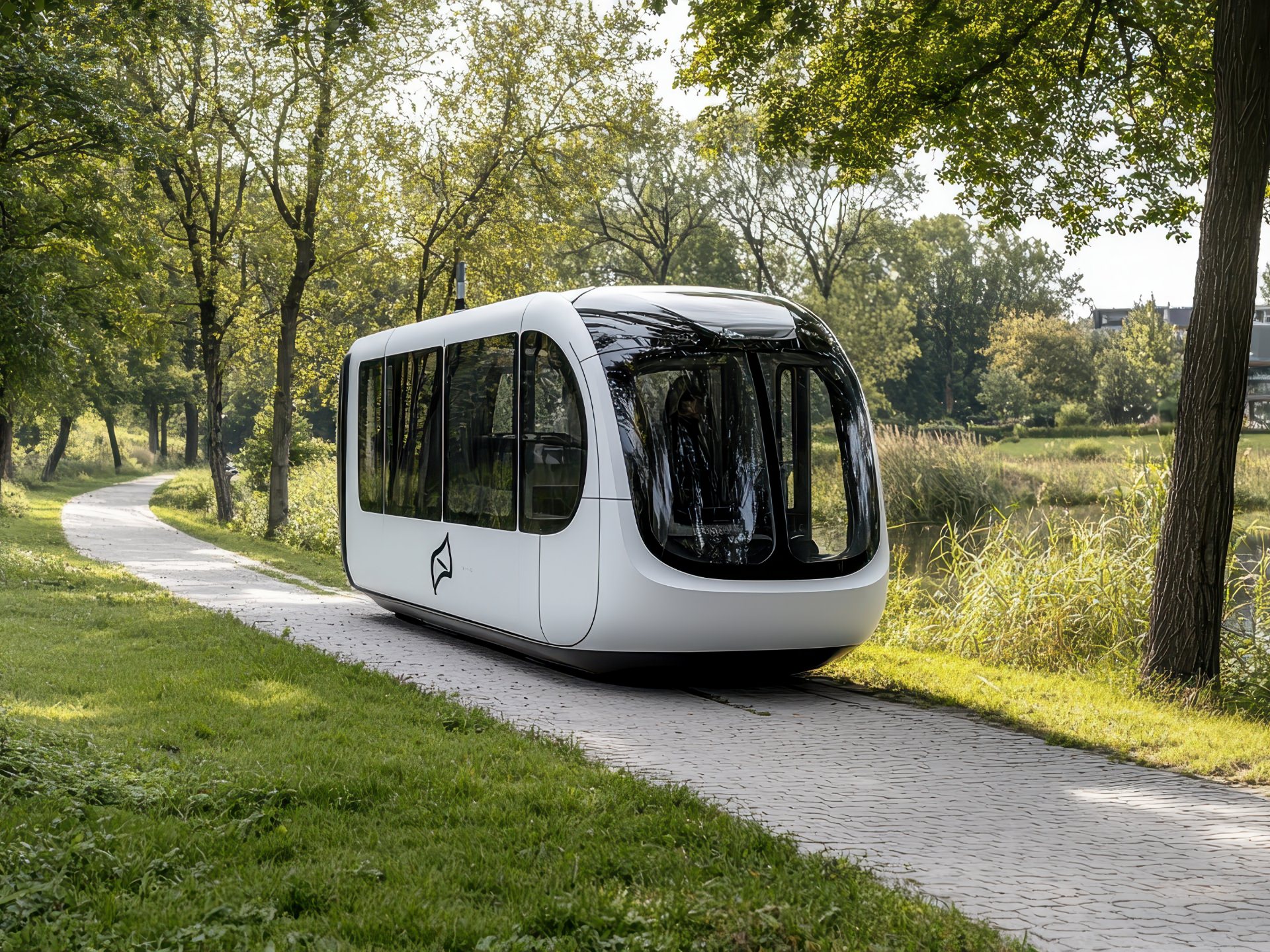
Ein Fahrzeug, das auf Knopfdruck zur Verfügung steht, den Passagier autonom und sicher zum Ziel bringt und sich nahtlos in den ÖPNV eingliedert: das ist innovative, zukunftsfähige Mobilität. Es ist ein Konzept, das schon häufig erprobt wurde. Autonome Shuttles bieten gute Vorrausetzungen, als bedarfsgerechtes Angebot im Mobilitätsmix vernetzter Mobilitätskonzepte im urbanen und ländlichen Raum nahtlos eingebunden zu werden.

In the cluster Vehicle, Infrastructure, Safety/Security & Processes, we create the technological foundation for automated driving – from AD systems and safety architectures to the digital integration into transport infrastructure. This is complemented by V&V methods and simulations to validate autonomous driving functions, as well as AI-based process automation to enable more efficient development and deployment.

AD system

We provide technologies and interfaces for all relevant system components that a vehicle needs to autonomously perform the driving task.
Our focus is on creating high-performance software, supplemented by custom-made hardware components where necessary.
The result is a robust, integrated AD system that provides the technical foundation for reliable and safe automated driving.

The technological foundation for automated driving

Safety architecture

We design robust architectures and implementations for functionally safe components, focusing on actuators and communication, to provide a solid basis for the safe operation of automated driving systems.
Our work centres on systematic risk assessment and the definition and demonstration of the software and hardware components required to achieve the specified safety levels and operational reliability.
Compliance with standards is the minimum requirement – our safety architecture has proven its reliability in real-world operation.

A reliable foundation for safe automated driving

Digital infrastructure

We establish the technical framework that enables automated vehicles to integrate seamlessly into an increasingly digital transport infrastructure. For instance, we facilitate connectivity with traffic lights and other infrastructure systems.
We also define interfaces with the digital back-end systems used in infrastructure and transport planning, as well as traffic management. This enables proven transport technology solutions to be adapted for use with automated vehicles, such as exclusive lane access at complex junctions. This allows safe and efficient turning manoeuvres to be performed in the presence of oncoming traffic.
The result is that automated mobility services can be introduced more quickly and safely, even under challenging traffic conditions.

Seamlessly integrating automated vehicles into the transport landscape

V&V methods, tools and simulation

We implement scalable, standardised methods for validating and verifying autonomous driving functions throughout the entire lifecycle and at all system levels – from individual components to the overall system.
Our focus is on open, interoperable toolchains and simulation-based testing methods that support functional verification and robust overall safety.
From the outset, we ensure that all methods and results meet the requirements for vehicle certification – enabling a seamless transition from development to regulated operation.

Safely verifying autonomous driving functions

AI-based process automation

We use artificial intelligence to make components, processes and operational workflows related to autonomous driving more efficient and to plan them effectively – whether for specific solutions or overarching system-wide contexts.
Our focus is on AI-based solutions that consolidate, simplify and restructure complex processes with the utmost precision and quality. One concrete example is the integration of continuous safety justification into the development process.
AI thus becomes a means of shortening development cycles, reducing sources of error, and sustainably accelerating autonomous driving solutions.

Making the development of autonomous driving more efficient

Regulatory Framework & Market

In the cluster Regulatory Framework & Market, we create the foundation for legally compliant, economically viable, and scalable mobility solutions. We integrate regulatory requirements early on, analyze costs and business models, and support the development of market-ready products as well as the transition from pilot projects to sustainable markets.

Regulatory framework

We analyse, apply and critically examine relevant international and national standards and legal regulations, focusing specifically on use cases for autonomous driving.
Our focus is on ensuring compliance with the requirements for the approval and market launch of autonomous mobility solutions, while continuously aligning with the demands of industrial product development.
We incorporate regulatory requirements as an integral part of the development process, not as an obstacle to be overcome later, but as a foundation from the very beginning.

Ensuring Legal Certainty for Autonomous Driving

Business model fundamentals and full-cost analysis

We examine the entire autonomous driving value chain from a business management perspective, breaking it down into different use cases and market scenarios.
Our focus is on identifying key cost drivers and developing concrete measures to reduce them, with the ultimate goal of establishing profitable supply and demand structures.
Our approach ensures that autonomous mobility solutions are not only technically feasible, but also commercially viable in the long term.

A cost-effective approach to autonomous driving

Economic framework conditions for digital value creation and products

We examine the economic framework conditions under which innovative digital products can be developed and succeed in the automated driving value chain.
The focus is on three key criteria: tangible product benefits, technological novelty, and economic added value, which form the basis for sustainable digital business models.
This enables technical innovations in autonomous driving to become market-ready products that deliver genuine added value and can compete with other offerings.

Making innovations market-ready

Scaling and market development

We identify and establish the key prerequisites for scaling up autonomous vehicles and their system technologies nationally and internationally, with a view to creating sustainable markets in the long term.
Our focus is on two areas: first, the further development of project results and pilot schemes into stable, scalable fleet operations; and second, the development of building blocks that will enable self-sustaining markets to emerge.
We support the transition from initial testing to achieving market readiness, laying the groundwork for automated driving to become an integral part of modern mobility systems.

Transforming pilot projects into successful markets

Piloting & Scaling

In the cluster Piloting & Scaling, we test and coordinate autonomous mobility solutions under real operating conditions, foster the exchange of best practices, and structure knowledge for effective transfer. KPI-based evaluations enable measurable assessment and targeted development for large-scale market deployment.

Pilot schemes and coordination of model regions

We plan and implement pilot schemes for autonomous vehicles and system technologies under real-world operating conditions, aiming to create practical blueprints that can be replicated on a large scale.
In addition, we offer coordination of various pilot initiatives, thereby facilitating a rapid, structured exchange of best practices – extending beyond individual pilot regions, both nationally and internationally.
This creates a dynamic network of experience and knowledge that accelerates the introduction of automated mobility, enabling others to benefit from successful solutions.

Testing real-world operations and scaling up insights

Knowledge management and transfer

We provide standardised training materials, knowledge formats and forums, as well as structured transfer processes tailored to key autonomous driving sectors.
In doing so, we consolidate global knowledge from research, industry and completed pilot projects, systematically prepare it and transfer it in a way that enables effective and high-quality fleet operations across a range of use cases – both nationally and internationally.
Experience-based knowledge is therefore not collected in isolation, but is systematically shared and made usable as a common foundation for the widespread introduction of autonomous mobility.

Leveraging global expertise in a targeted manner

KPI-based evaluation

We define and monitor key performance indicators to enable the achievement of objectives through autonomous system technology, measuring and assessing performance across all relevant dimensions.
Five evaluation criteria are considered: transport efficiency, penetration of profitable markets, contribution to the ecological transformation of the transport sector, resilience of systems, and public acceptance of the technology.
With a view to future requirements, dual-use KPIs are also integrated into the evaluation framework.
This makes impact measurable and enables development to be steered in a targeted manner based on a robust, multidimensional evaluation framework.

Making the impact of autonomous mobility measurable

Tools & References

In the cluster Tools & References, we establish reference architectures and modular KITs for transferable, ready-to-deploy solutions. An integration architecture provides the foundation for connected, interoperable systems, while community approaches and a central back office support collaboration, implementation, and scaling.

Reference architectures and kits

We design reference architectures and KITs (Keep It Together). These are used to ensure that use cases within the mobility ecosystem can be implemented in a structured, reusable and rapid manner. Reference architectures describe proven solution models for use cases, while KITs bundle all the necessary digital components into ready-to-use packages.
Our focus is on transferability and practical usability. Different solution approaches are systematically mapped and rapidly translated into real-world applications through open, standardised structures.
The results in interoperable, ready-to-use solutions for the accelerated deployment of innovative mobility services.

Implementing solutions in a structured manner

Integration architecture

We are planning a comprehensive integration architecture to serve as a conceptual framework for interconnecting IT systems in the mobility sector. This architecture defines the fundamental principles, structures, and interfaces that ensure different solutions work together seamlessly, both within and across organisational boundaries.
The focus is on clear design principles, such as vendor neutrality, open standards, secure digital identities and data and technology sovereignty. These are complemented by modern data room technologies that ensure transparency, traceability, and data protection.
The result is a consistent, interoperable system framework — an ‘operating system for mobility’ — into which specific applications and reference architectures can be seamlessly integrated. This forms the basis for a sustainable, scalable IT landscape.

Common guidelines for a connected mobility system

Community building and management, back office

We are building a cross-sector community and establishing the organisational foundations for the Ecosystem Mobility 4.0 initiative through a central back office.
Stakeholders from industry, the public sector, politics, and associations are jointly crafting a vision for the future of mobility and devising practical solutions. The focus is on clear processes and roles, from establishing the framework and setting up the structure, to implementation and scaling up. The back office provides support through coordination, communication, and organising use cases and KITs.
The result is a connected, proactive community that acts as a driver for coordinated, sustainable mobility solutions.

Structuring and driving collaboration